Infographic: Microprocessors
More from the Category
Follow Our Socials
A microprocessor is the central unit of a computer system, commonly referred to as the "brain" of a computer. It is an integrated circuit (IC) that performs arithmetic, logic, control, and input/output (I/O) operations specified by software instructions. By executing these instructions, the microprocessor manages data processing, coordinates communication between system components, and controls the overall operation of a device. Microprocessors replace traditional hardwired circuits with a programmable solution, making modern electronic devices more flexible, efficient, and capable of performing a wide range of functions.
Microprocessors are used in a variety of applications, including personal computers, smartphones, industrial equipment, automotive systems, and embedded devices. Their ability to execute software instructions quickly and accurately makes them a fundamental component of modern electronics and computing systems.
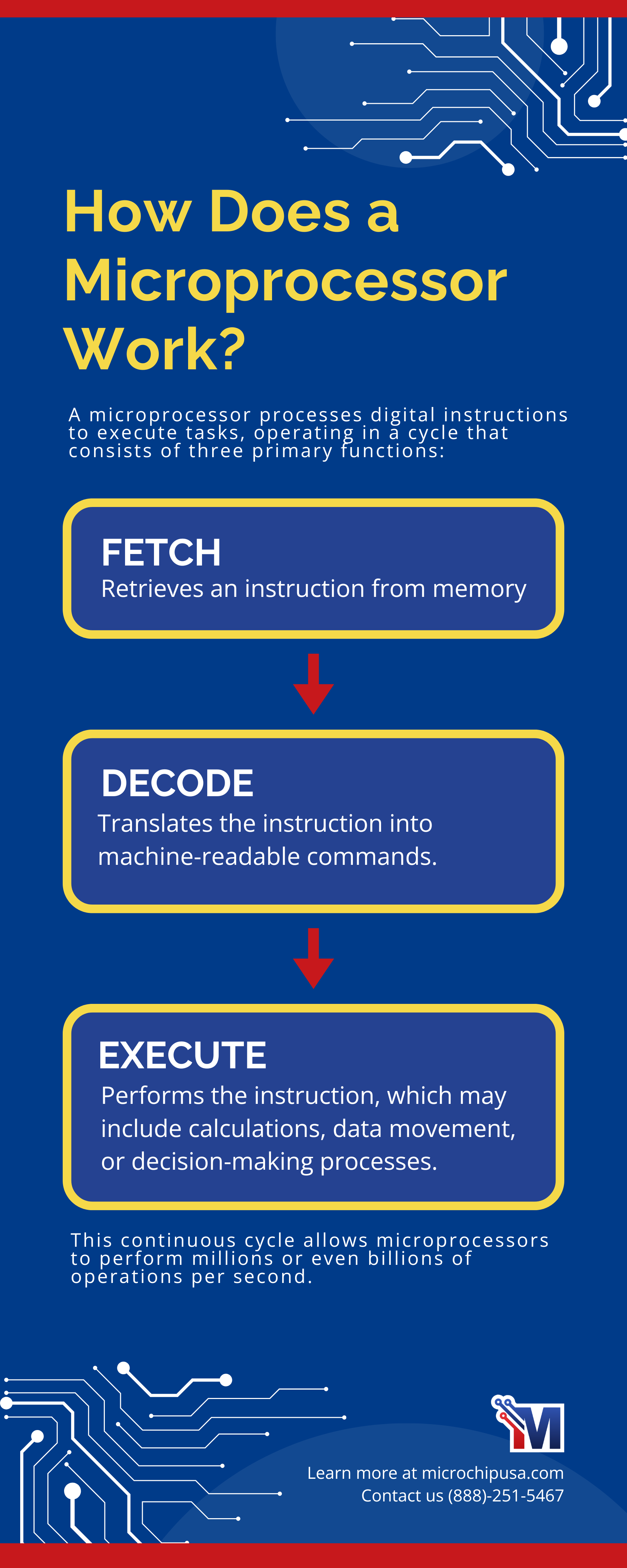
A microprocessor operates by executing digital instructions in a continuous cycle consisting of three primary functions: fetch, decode, and execute. This cycle repeats continuously while the system is operating, allowing the processor to perform calculations, process data, and manage system resources in real time.
This continuous cycle enables microprocessors to perform millions, or even billions, of operations per second, powering everything from personal computers to embedded systems. Their high-speed processing capabilities allow modern electronic devices to handle increasingly complex tasks while maintaining reliable and efficient performance.
Types of Microprocessors
There are several types of microprocessors, each designed for specific applications:
General-Purpose Microprocessors (GPPs): Used in personal computers and servers, such as Intel Core, AMD Ryzen, and ARM-based processors.
Microcontrollers (MCUs): Compact processors with integrated memory and peripherals, commonly found in embedded systems.
Digital Signal Processors (DSPs): Optimized for high-speed mathematical operations in applications like audio processing and telecommunications.
Application-Specific Integrated Circuits (ASICs): Custom-designed processors for specialized tasks, such as cryptocurrency mining or AI acceleration.
RISC vs. CISC Processors: Reduced Instruction Set Computing (RISC) processors, such as ARM, emphasize efficiency and performance, while Complex Instruction Set Computing (CISC) processors, such as x86, offer powerful computing capabilities.
Common Applications of Microprocessors
Microprocessors are used in a vast array of applications across industries. Some of the most common include:
Computers & Servers: The core processing unit of desktops, laptops, and data centers.
Embedded Systems: Found in household appliances, automotive control systems, industrial automation, and medical devices.
Mobile Devices: Powering smartphones, tablets, and wearables.
Consumer Electronics: Used in gaming consoles, smart TVs, and digital cameras.
Aerospace & Defense: Critical for avionics, navigation systems, and missile guidance.
Automotive Industry: Enabling advanced driver-assistance systems (ADAS), engine control units (ECUs), and infotainment systems.
The Birth of the Modern Microprocessor: Intel 4004
The first commercially available microprocessor, the Intel 4004, was introduced in 1971 and marked a turning point in computing history. Developed in collaboration with the Japanese calculator company Busicom, the 4004 was the first CPU on a single silicon chip. It replaced complex hardwired circuits with a programmable solution, allowing devices to execute various tasks with software commands.
Learn More: The First Intel Microprocessor
Key Contributors to the Intel 4004 Development
Ted Hoff: Conceptualized the architecture and saw its potential for replacing fixed-function logic circuits.
Federico Faggin: Led the silicon design and implemented the microprocessor using silicon gate technology, enabling a compact and efficient design.
Masatoshi Shima: Designed the logic and functional structure to meet Busicom’s calculator needs.
With just 2,300 transistors and a clock speed of 740 kHz, the 4004 powered early calculators but paved the way for the CPUs that now drive everything from smartphones to supercomputers.
The Lasting Impact of Microprocessors
The introduction of the microprocessor revolutionized technology, making electronic systems smaller, more powerful, and highly versatile. Today, microprocessors are at the heart of countless industries, shaping the future of computing, artificial intelligence, and automation.
Find Microprocessors
Whether you're designing embedded systems, advancing industrial automation, or sourcing components for high-performance computing applications, we are here to help. As a certified independent distributor and full-line supplier of electronic components, we provide access to a broad portfolio of microprocessors, microcontrollers, semiconductors, and other electronic components from the industry's leading manufacturers.
Backed by our ISO 9001:2015, AS9120, ISO 14001:2015, and ISO/IEC 27001 certifications, as well as our GIDEP membership and ITAR compliance, we are committed to delivering quality-assured products, dependable sourcing solutions, and exceptional customer support. Request a quote below.
More from the Category
Follow Our Socials
Line Cards We Support